Copilot Studio
 M365 Copilot
 Copilot Cowork
 Autopilots
 Governance
For as long as Microsoft has been in the AI game in any serious way, a persistent criticism has followed them around: they aggregate. They invest. They partner. They integrate other people's work into their products and call it a strategy. And to be honest, that criticism isn't entirely wrong.
Yes, there are the Phi models. That small language model family has quietly punched above its weight in math and reasoning tasks. But Phi was never a real answer to the question of whether Microsoft could build frontier-grade AI. It was more like a polite rebuttal. At Build 2026, Microsoft AI CEO Mustafa Suleyman walked on stage and delivered something much louder than the Phi polite rebuttal. And this rebuttal was long overdue.
A Brief History of Microsoft AI
While not part of the official story, what may have set all of this into motion was the short-lived public drama and turmoil at OpenAI in November 2023. In the space of 4-5 days, OpenAI's CEO Sam Altman was fired, Microsoft offered him a job, nearly all of OpenAI's employees threatened to quit, and Microsoft indicated they would be prepared to hire a large number of those employees. Microsoft's CEO Satya Nadella announced that Sam Altman would lead a new advanced AI research group inside Microsoft, and would be joined by OpenAI President Greg Brockman. When the dust settled and Sam returned to OpenAI, the seeds had been sown for what would eventually become Microsoft AI. About four months later, Mustafa Suleyman joined to head up this new org. Even as Microsoft continued to support and invest in OpenAI, it was evident that at some point, the Microsoft AI org would be bringing their own models to the marketplace.
The Big Microsoft AI announcement at Build 2026
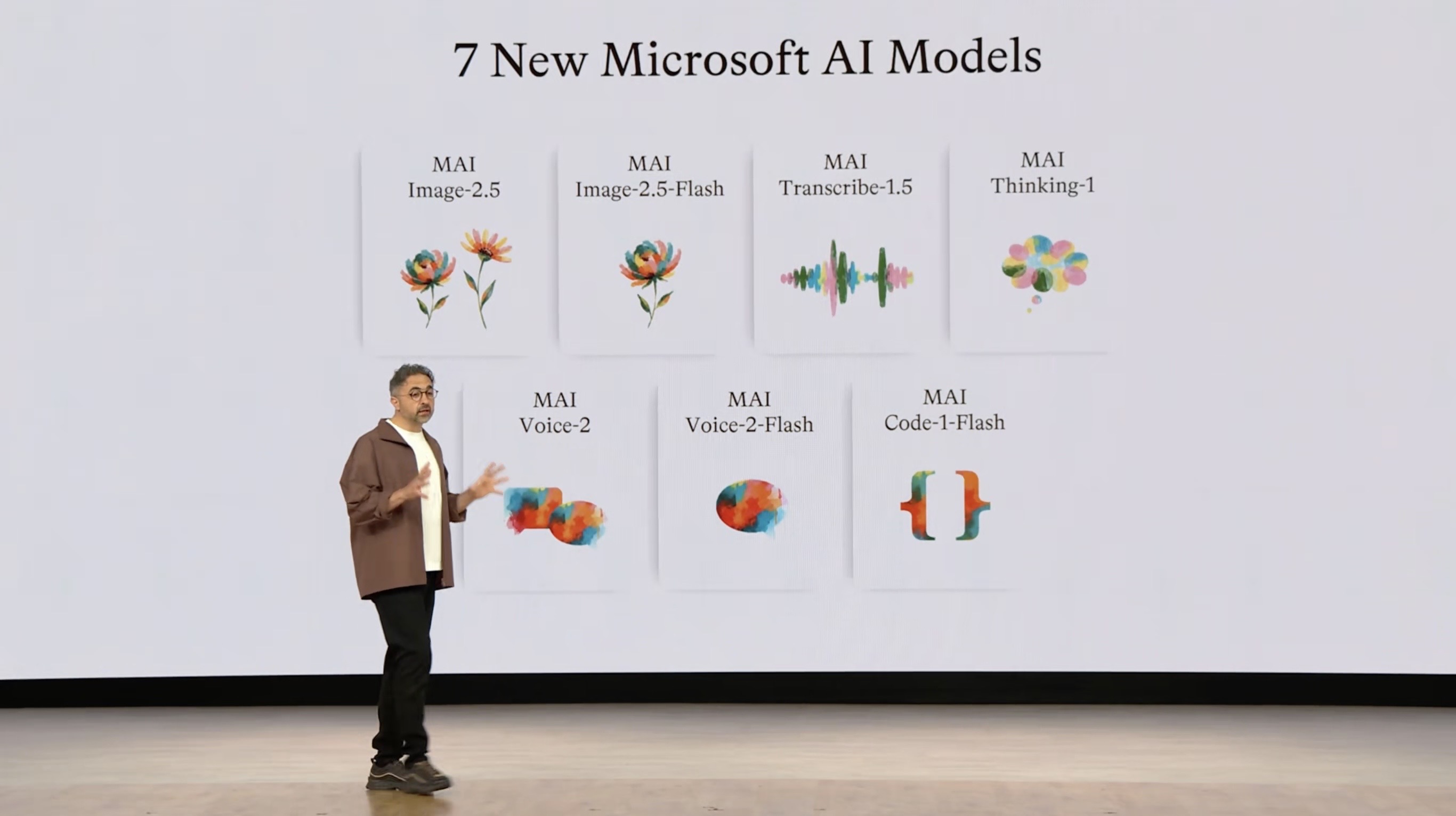
In what felt like a keynote within a keynote, Mustafa Suleyman got up on stage and promptly announced a new family of in-house MAI models, signaling a broader shift in the company's AI strategy. The headline: seven new models across reasoning, coding, image generation, transcription, and voice. Let's go through them.
MAI-Thinking-1: The Flagship Reasoner
A 35B active parameter Mixture-of-Experts model with a 256K context window. It benchmarks alongside Anthropic's Opus 4.6 on SWE-Bench Pro and achieves 97% on AIME 2025. Built from scratch on clean, commercially licensed data with zero distillation from third-party models.
MAI-Code-1-Flash: The Lean Coding Model
A 5B parameter coding model, comparable in size to Claude Haiku but cheaper. It hits 51% on SWE-Bench Pro and is rolling out now as a default model in VS Code.
MAI-Image-2.5 and MAI-Image-2.5-Flash: Two Image Models for Different Jobs
MAI-Image-2.5 is currently number two on the Arena image leaderboards, already live in PowerPoint and rolling out to OneDrive. The flagship is for high-fidelity work. The Flash variant is for fast, scalable production use cases.
MAI-Transcribe-1.5: Transcription Built for the Real World
43 languages, state-of-the-art accuracy, up to 5x faster than rival models. Supports keyword biasing for domain-specific terminology. Being integrated into Copilot, Teams, GitHub, and Dynamics 365 Contact Center.
MAI-Voice-2 and MAI-Voice-2-Flash: Speech Generation at Two Price Points
MAI-Voice-2 delivers natural, emotionally expressive speech across multiple languages, with voice adaptation from a short reference clip and consent guardrails built in.MAI-Voice-2-Flash is the ultra-low-latency variant built for real-time voice agents.
Flagship and Flash: Microsoft's Got Both Angles Covered
It is worth stepping back and noticing that several of these models come in two tiers. That is by design - a product philosophy. When you are building for agent-scale deployments, you need a premium model for when quality is non-negotiable and a faster, cheaper model for the high-volume, iterative work that happens around it. Microsoft building both across multiple categories tells me they are thinking like a platform company, not a research lab trying to win a leaderboard.
Frontier Tuning: AI Models For Your Business
If there is one thing from this keynote I think deserves more attention than it is getting, it is Microsoft Frontier Tuning.
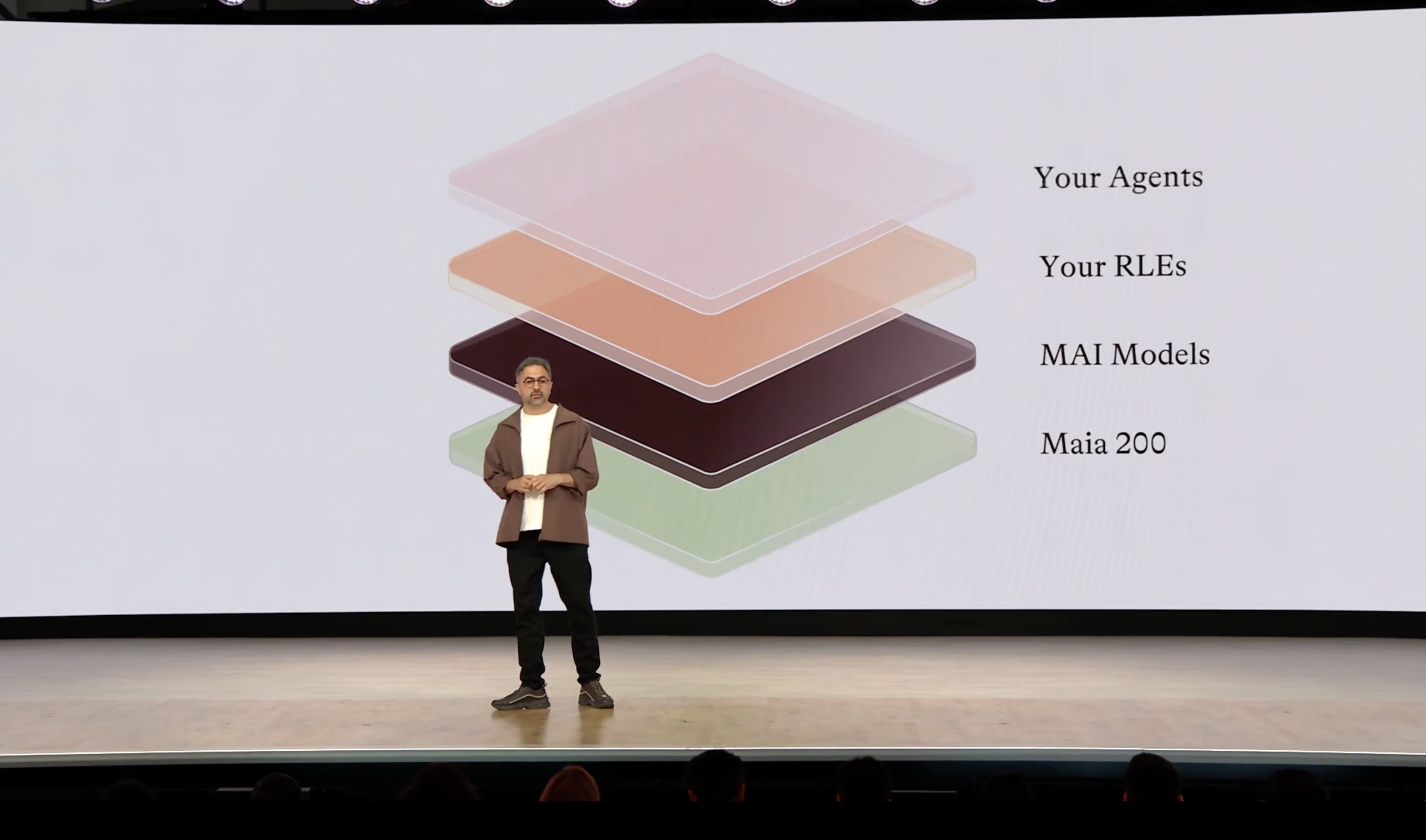
The idea is that organizations can tune MAI models on their own workflows, inside their own environments, using reinforcement learning environments that capture how real work gets done. Microsoft describes these as private "training gyms" where the model learns from task traces, decisions, tools, and process patterns specific to an organization. The example Microsoft shared: when they tuned MAI models for McKinsey's workflows, MAI outperformed GPT-5.5 on quality while running at 10x lower cost.
Suleyman proudly stated that unlike with some other companies, with MAI you don't rent intelligence from a shared model that learns from everyone. Only you keep the benefits of your hard-earned workflows, know-how, data and institutional knowledge. Only you control the resulting model. The RLEs and the models you build inside of them become your moat.
So, Is Microsoft Done Renting AI?
Not entirely, and that's okay. M365 Copilot still runs on GPT and Claude. Microsoft's investment in OpenAI is not going anywhere, neither is their partnership with Anthropic. Nor should it. OpenAI builds excellent models and Microsoft has every reason to keep that relationship healthy.
But what remains to be seen is IF and HOW QUICKLY one or more of these MAI models will become available in M365 Copilot and Copilot Studio, and if an MAI model will become the default model for either or both of these platforms.
What became clear at Build 2026 is that Microsoft is no longer comfortable letting model building be entirely someone else's job. Seven models across five capability categories. Flagship and Flash tiers across the board. Zero third-party distillation on the flagship reasoning model. Their own silicon, the Maia 200 chip, co-designed with their models for a 1.4x performance-per-watt gain. And a tuning framework that could genuinely shift how enterprises think about AI investment.
Microsoft is not done renting. But it is clearly building an exit ramp, and at Build 2026, it showed exactly where that ramp leads.
What is your take on the MAI model family? Does this change how you think about Microsoft as an AI builder, or are you waiting to see how these models perform in the real world? I would love to hear from you.
My final thoughts: When Microsoft rolled out the Phi family of models, it barely made a whimper of a sound. But the MAI family of models? They're coming at us like a locomotive, loud, fast, and impressive.
Sources:
Microsoft Build 2026: 7 New Microsoft AI Models, Christian Coello, LinkedIn