Copilot Studio
 M365 Copilot
 Copilot Cowork
 Autopilots
 Governance
Microsoft used its Build 2026 keynote to pull back the curtain on Project Solara, a chip-to-cloud platform designed not to make apps smarter, but to replace them entirely with AI agents. It is an early-stage initiative, and Microsoft is the first to say so. But the ambition behind it is hard to miss.
What Is Project Solara?
Project Solara is a software platform paired with tailored hardware solutions, designed from the ground up to pioneer agent-first experiences shaped around you: your agents, your tasks, your environment, under your control. The platform is built on a simple premise: the next platform shift is from apps to agents -- from software you open to intelligence you invoke, from graphical interfaces of buttons to expressing intent through agents, and from AI operating inside your applications to agents working outside and across your apps, workflows, and devices. The "operating system" is described as liminal, transcending the device and the cloud. The system brings a lightweight window to the edge where the agent manifests, while state, via Azure, encompasses a constellation of specialized devices. Steven Bathiche, the Microsoft corporate vice president and technical fellow who leads the Applied Sciences Group, has been making this argument for years: computers keep moving closer to us, closer to the work, closer to the moment where they add value. Solara is where his team lands on what "closer" looks like next.
Two Devices, Many Possibilities
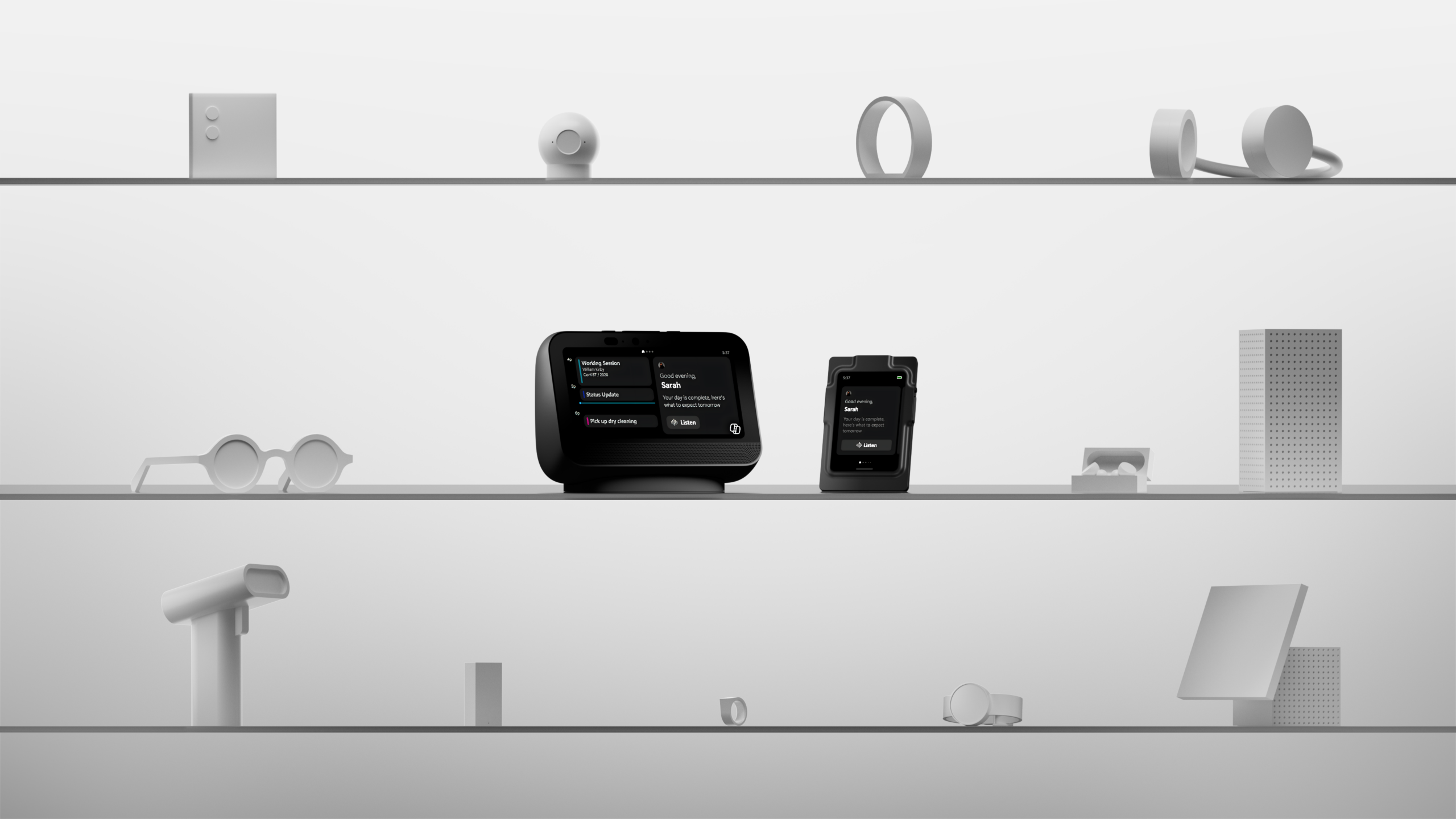
Microsoft showed two concept devices at Build. Neither will ship under the Microsoft brand. They are reference designs, intended to give hardware partners a starting point.
The first is a desktop hub that sits beside a PC, responds to voice commands, signs users in using facial recognition, and surfaces the day's most pressing items. With a monitor attached, it becomes a full Windows machine running in the cloud. The second is a wearable badge that reimagines the standard employee ID card. A fingerprint button wakes an agent in one press, a single tap records and transcribes a conversation, and a built-in camera lets the agent act on what the user sees. It is the kind of device that makes you realize your standard-issue ID card has been underperforming for decades.
Both devices run multiple agents simultaneously, with a coordination layer that routes tasks to whichever agent is best suited. Bathiche noted the team had the badge running on the platform in roughly three days, using the same software stack as the desk device on a different chipset. That speed is the point.
Why Copilot Users Should Pay Attention
This is where it gets interesting for anyone already working in the Microsoft agent ecosystem.
Project Solara is designed for an open, multiple-agent world. Organizations will use Microsoft agents where they add value, and will also source or build their own agents for their specific workflows and requirements. The platform brings these agents together coherently, while respecting boundaries between data, domains, identities, and organizations. Microsoft offers its own agents, including Microsoft 365 Copilot, but the platform is designed for organizations to use other agents as well. In practical terms, the Copilot capabilities your organization has already built and deployed are potential first-class citizens on whatever Solara-based hardware your partners eventually ship.
Microsoft is also investing in just-in-time UI: the ability for an agent experience to adapt across devices and modalities without requiring developers to redesign everything for every new form factor. Today, that means semi-structured approaches like adaptive cards and known content types. Over time, it moves toward more dynamic and generative interfaces. For anyone building in Copilot Studio, that trajectory is worth watching.
Enterprise-Grade From the Foundation
The operating system is the Microsoft Device Ecosystem Platform, or MDEP, an enterprise version of Android that Microsoft developed for devices including Teams meeting-room hardware. The company chose MDEP over Windows deliberately, to run on smaller, lower-power devices while keeping the management and security features IT departments expect: patch and over-the-air updates, device integrity, Microsoft Defender, Intune, and Entra ID sign-in. Chip partners are Qualcomm and MediaTek, both using off-the-shelf silicon, not custom chips. Keeping hardware cheap and fast to build is central to how Microsoft plans to enable new device form factors at scale.
Who Is Piloting It
In the coming months, companies including AccuWeather, Best Buy, CVS Health, Levi's, and Target are expected to begin pilots of devices based on the reference designs. The healthcare demo shown by Microsoft illustrated the concept well: a badge-wearing health worker scanning a patient QR code, recording and transcribing the visit, logging vitals, and initiating a prescription, all through agents. Microsoft was clear that this is a concept demonstration, not a clinical tool ready for deployment.
How Early Is Early?
The project is still very early, by Microsoft's own admission. There is no public shipping timeline, no finalized pricing model, and the business model is still taking shape. Bathiche said CEO Satya Nadella liked what the team was doing and suggested showing it at Build much sooner than the company would normally surface this kind of behind-the-scenes work. The competitive pressure in the AI space made waiting feel like a bad idea.
That context matters. Project Solara is a directional signal, not a product launch. But the direction is unmistakable: Microsoft believes the next wave of computing is not about better apps on familiar hardware. It is about agents built into the environments and workflows where people actually operate.
For anyone tracking the Copilot and agentic ecosystem, this is one to follow closely.
Learn More
- Composing a new platform for agent-first devices — Command Line, Microsoft
- Project Solara: A new vision for agent-first computing — YouTube