Copilot Studio
 M365 Copilot
 Copilot Cowork
 Autopilots
 Governance
To think that it was only November 2023 when Microsoft officially announced Copilot Studio (or rebranded Power Virtual Agents as Copilot Studio). That was followed up with the general availability of Copilot for Microsoft 365 in January.
Since then, there has been a significant update or announcement almost every week or two, whether it's a new feature, a new Copilot, or a new partnership. Speaking of partnerships, one misconception that people have is that Microsoft has put all its eggs in OpenAI's basket. Nothing could be farther from the truth.
Yes, OpenAI is a major partner and Microsoft has invested heavily in its growth, as well as chosen to go with OpenAI's GPT LLMs to power Copilot for M365 and Copilot Studio. But they have invested just as much in other partners and making their models available to AI solution builders in the Azure AI Foundry (formerly Azure AI Service). We're not talking about 50, 100, or even 500 models. As of January 2025, Microsoft's partnerships have brought forth 1,820 models to Azure AI Foundry for builders to choose from.
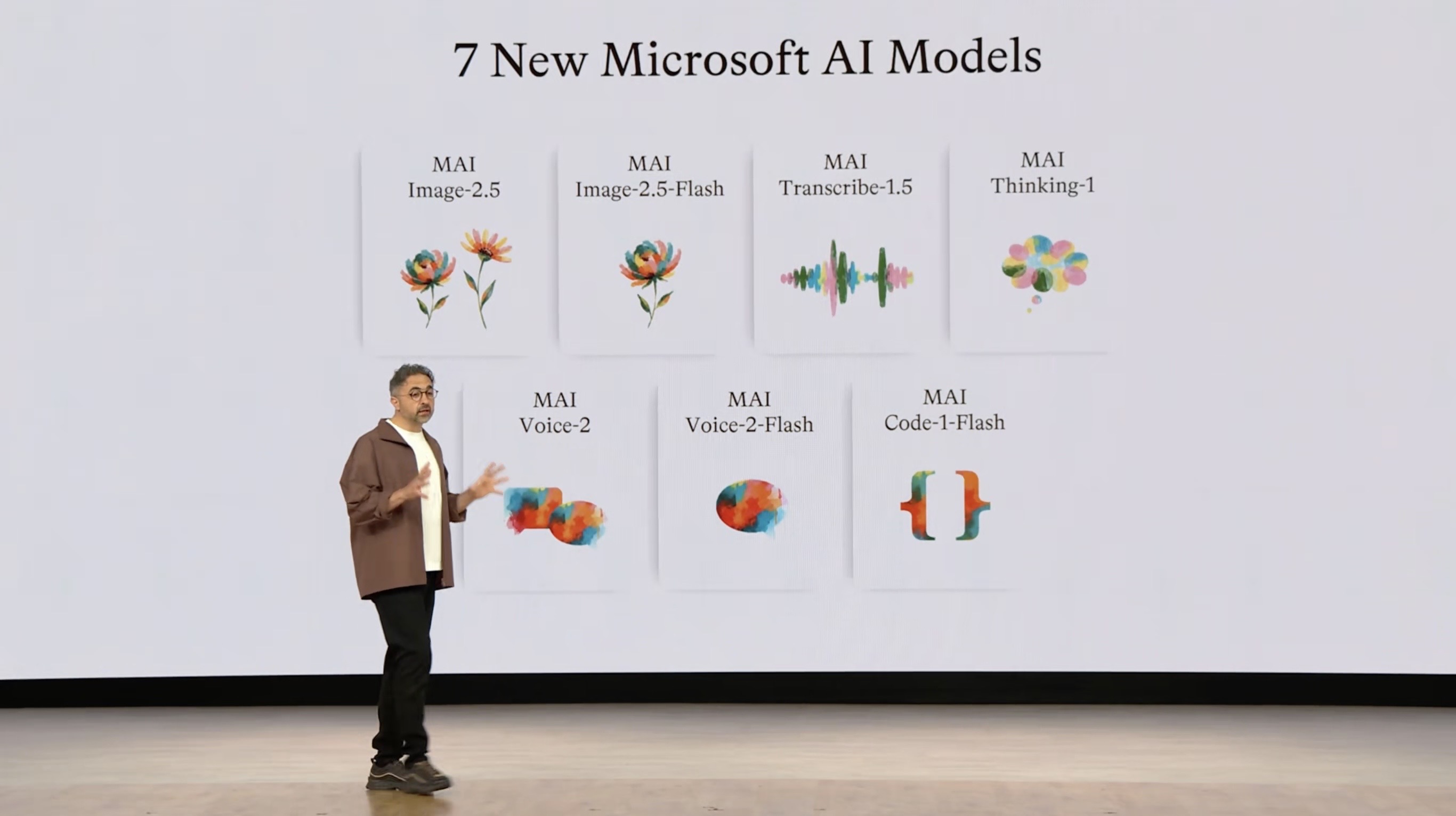
Even more significantly, Microsoft continues to invest in its own models as well such as Phi-3, Phi-4, etc. as well building in-house finetuned versions of third-party models like Orca-2 which is based on Meta's LLAMA-2.
When things got messy at OpenAI's board, Microsoft helped bring stability to the situation, first by offering to bring the briefly exiled CEO Sal Altman in-house along with the many folks who were planning to leave or were going to be let go. By the time the brief misadventure ended and Altman resumed his role at OpenAI, Microsoft ended up with a stronger presence on OpenAI's board to help provide governance and oversight. But more significantly, they also started their own in-house Microsoft AI organization and brought in Mustafa Suleyman as its CEO. Mustafa was a co-founder of DeepMind (now owned by Google) and later Inflection AI. This ensured that Microsoft could continue to benefit from its investment in OpenAI in the short-to-medium term while still being in control of its AI destiny in the long-term.
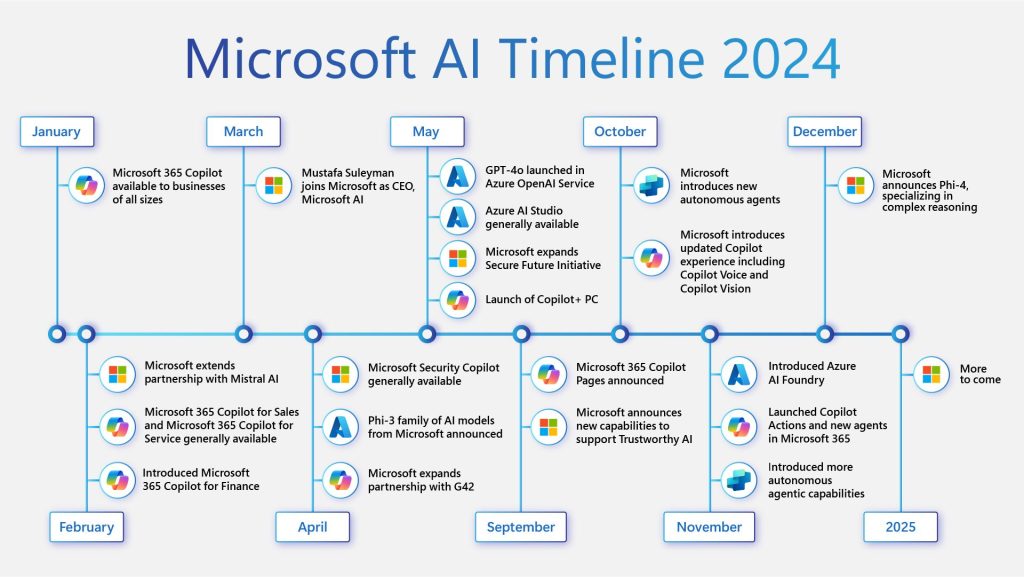
Mid-year, Microsoft announced general availability of the Security Copilot and the Azure AI Studio. Shortly after came the launch of Copilot+PCs powered by ARM processors for longer battery life, as well as an NPU for handling AI tasks quicker.
As we entered the last quarter of the calendar year, new feature announcements came fast and furious. First came Copilot Pages to unlock greater collaboration for teams using Copilot for M365. That was followed by the introduction of Autonomous Agents and a general renaming of custom Copilots as Agents. Then we got Voice and Vision capabilities in the consumer version of Copilot, along with a slew of announcements at Microsoft's flagship Ignite conference. As the year drew to a close, Microsoft announced the release of Phi-4, an in-house developed 14-billion parameter small language model (SLM) that can outperform many larger models in math-related reasoning tasks.
While 2025 promises to be a great year for AI, it remains to be seen if Microsoft can continue to develop at the same breakneck pace.
What stood out to you most from Microsoft's AI journey in 2024? I want to hear your thoughts!